Why your boiler pressure keeps dropping, where the water is going, and how to repressurise a combi safely
A sealed heating system should hold its pressure for months. When the gauge keeps sinking, water is leaving by one of a few routes, and the pattern of the drop tells you which before anyone opens the boiler.
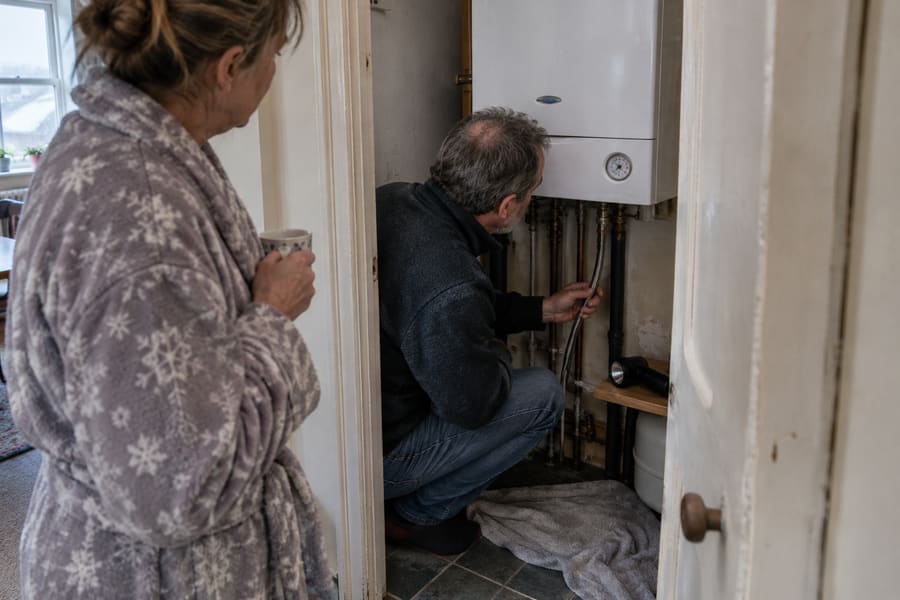
Illustration Anaradio picture desk
The short answer
Boiler pressure drops because water is leaving a sealed heating circuit. The usual routes are a slow leak at a radiator valve or joint, a pressure relief valve dripping through the copper pipe outside, or a flat expansion vessel that pushes pressure towards 3 bar when hot so water is dumped. Bleeding radiators lowers it too. Top up to 1 to 1.5 bar cold; if you need to more than twice a year, call a heating engineer.
At a glance
- A sealed heating system uses no water, so a falling gauge always means water is leaving or the expansion vessel has failed.
- Fill to 1 to 1.5 bar with the system cold; a rise of a few tenths when hot is normal.
- Pressure that surges towards 3 bar when hot and sinks when cold points to a flat expansion vessel.
- A wet or stained copper pipe on the outside wall means the pressure relief valve has opened or will not reseat.
- Weekly top-ups dilute the corrosion inhibitor and feed sludge, so find the leak rather than keep refilling the system.
It usually shows up on a cold morning. The radiators stay lukewarm, the hot tap runs cold, and the little needle on the front of the boiler is lying almost flat against the red zone. You open the filling valve, the needle climbs back to 1.2, the boiler lights, and life goes on. A fortnight later the needle is down again.
A combi or system boiler runs on a sealed circuit: the same water goes round the pipes and radiators for years, and none of it is supposed to leave. So a falling gauge is not a mood of the boiler. It is a measurement that water is escaping somewhere, or that something inside is no longer absorbing the swing between cold and hot. There are only a handful of routes out, and the way the pressure falls tells you which one you are dealing with, usually before anyone has to take a cover off.
What the boiler pressure gauge is actually measuring
The gauge reads the pressure of the water in the heating circuit above the air around it, in bar. One bar is enough to hold a column of water about 10 metres high. That is why a sealed system is filled to roughly 1 bar: it has to push water to the top of the highest radiator and still leave some pressure there, so that air does not creep in through the joints and the pump does not starve.
Water also grows as it heats. Between a cold system and a flow temperature around 80°C it expands by close to 3 per cent, so a circuit holding 100 litres, a plausible figure for a family house, gains about 3 litres of volume every time the heating comes on. Those litres have to go somewhere. In a healthy system they go into the expansion vessel, a steel tank split by a rubber diaphragm, with water on one side and a cushion of compressed air or nitrogen on the other. The air squeezes, the pressure rises a little, and when the system cools the cushion pushes the water back.
A rise of a few tenths of a bar between cold and hot is the vessel doing its job. A rise to almost 3 bar, or a reading that sinks steadily over days or weeks, is the gauge telling you something has changed.
| Reading | System state | What it suggests |
|---|---|---|
| Below 0.5 bar | Cold | Too low; most boilers lock out |
| 0.5 to 1 bar | Cold | Low; top up and start watching |
| 1 to 1.5 bar | Cold | Normal |
| 1.5 to 2.5 bar | Hot | Normal rise while heating runs |
| Close to 3 bar | Hot | Overfilled or flat expansion vessel |
| Swings 1 bar or more | Cold to hot | Expansion vessel not absorbing heat growth |
The five routes water takes out of a sealed system
Every case of falling pressure fits one of these. Some are perfectly normal, two are slow leaks you can often find yourself, and two need an engineer.
Bleeding radiators and a newly filled system
Air in a radiator takes up space that was holding pressure. Let it out through the bleed valve and the gauge drops, often by a few tenths of a bar after a round of bleeding. The same happens for a few weeks after new radiators are fitted or the system is drained: dissolved air comes out of the fresh water, collects in the high points and escapes through the automatic air vent on the boiler. A drop that follows bleeding, or that settles once the system has bedded in, needs one top-up and nothing else.
A slow leak on the circuit
This is the commonest real fault. Radiator valves are the usual culprits, particularly the gland nut where the spindle enters the valve body, followed by compression joints, towel rails and the tails behind radiators. A drip every few minutes onto a warm floor can evaporate before it ever forms a puddle, which is why so many leaks are invisible. Pipes buried in a concrete floor or running under floorboards add another class of leak that only shows as a damp patch, a stain on a ceiling below, or a warm spot on the floor.
A pressure relief valve that is letting by
Every sealed system has a pressure relief valve, a spring-loaded safety valve that opens at 3 bar so the circuit cannot burst. It discharges through a copper pipe, usually 15 mm, that runs through the outside wall and often ends turned back towards the brickwork. Once that valve has opened a few times, grit can stop it reseating, and it lets water by in a slow trickle. The giveaway is outside: a damp tip, a green or white stain on the wall beneath it, or a drip after the heating has been on.
A flat expansion vessel
The air cushion in the vessel leaks away slowly over years, or the diaphragm splits. With no cushion, the extra 3 litres from heating have nowhere to go, so the pressure shoots towards 3 bar every time the heating runs. The relief valve opens, dumps water, and when the system cools the pressure collapses below where it started. Each heating cycle loses a little more. People in this situation often top up to 1.5 bar, watch it climb to 3, and conclude the boiler is overpressurising, when the vessel is the real fault and the low reading next morning is just its shadow.
A leak inside the boiler
Pump seals, internal pipe joints, the automatic air vent and the heat exchanger can all weep inside the casing. Look for drips or staining on the pipes directly under the boiler, or a tidemark on the wall below it. An internal leak is not a DIY job: on most boilers the casing forms part of the seal that keeps combustion gases out of the room.
Read the pattern of the drop before hunting for the leak
The speed and timing of the drop are the best evidence you have. As with working out which pipe a gurgling drain is complaining about, you locate the fault from the pattern first and pick up a spanner second. Watch the gauge cold first thing, hot in the evening, and note what you did in between.
| What the gauge does | Likely cause | First check |
|---|---|---|
| Drops once, right after bleeding | Air released | Top up, then watch a week |
| Drops steadily, heating on or off | Leak on the circuit | Valves, joints, ceilings, floors |
| Climbs near 3 bar hot, low when cold | Flat expansion vessel | Outside discharge pipe |
| Drops mainly after heating runs | Relief valve letting by | Wet tip on outside pipe |
| Water on pipes under the boiler | Internal leak | Book an engineer |
| Rises on its own, even cold | Filling loop not fully shut | Both filling valves |
A slow drop of a tenth of a bar over several weeks is within the range of normal settling on some systems. Losing half a bar in a few days is a fault. Losing a full bar overnight means a leak you should be able to find, because that is several litres of water.
How to find a heating leak you cannot see
Start with a clean baseline. Top the system up to 1.2 bar with the heating off and cold, photograph the gauge, and leave the heating off for 24 hours if the weather allows. If the pressure still falls with no heat in the system, you have a leak on the circuit, because the vessel and relief valve only misbehave when the water expands. If it holds cold but falls after heating cycles, look at the relief valve and vessel. Change one thing at a time and give each change a day, the same patience that fixing a fridge that freezes its contents demands.
How to repressurise a combi boiler safely
Topping up is done through the filling loop, a connection between the mains cold supply and the heating circuit. On many boilers it is a braided silver hose with a small valve at each end, sitting under the boiler. Others have a built-in lever or tap, or a plastic key that slots into the base of the boiler. The manual for your model shows which you have, and where.
Topping up the pressure
-
Switch off and let it cool
Turn the heating off and wait until the radiators are cold, around an hour. A reading taken hot is inflated by expansion, so you would end up overfilling.
-
Check the loop is connected
If you have a removable hose, screw both ends on hand tight. Make sure the valves are closed before you start.
-
Open the valves slowly
Open one valve fully, then open the second a quarter turn at a time. You will hear water hiss in. The needle should move steadily, not jump.
-
Stop at 1 to 1.5 bar
Watch the gauge throughout and close both valves when it reaches the figure in your manual, typically 1.2 to 1.5 bar cold. Close them fully; a valve left slightly open will keep raising the pressure.
-
Disconnect and tidy
Unscrew a removable hose with a cloth underneath to catch the cupful of water in it. Water regulations require the temporary connection between drinking water and heating water to be broken after use.
-
Reset and record
Reset the boiler if it shows a fault, put the heating on, and write down the cold reading and the date. That note is the first entry in your diagnosis.
Why topping up every week is not a harmless habit
It is tempting to treat a leaking system as one that simply needs feeding. The trouble is what each refill brings with it. Fresh mains water carries dissolved oxygen and minerals, and it dilutes the corrosion inhibitor, the chemical added to the heating water to stop steel radiators rusting from the inside. Every top-up restarts corrosion a little. The rust becomes black sludge, the sludge settles in the bottoms of radiators and the boiler's narrow heat exchanger, and the system begins to fail in new ways: cold spots, a noisy boiler, a blocked pump.
Hard-water areas add limescale to the list. Heat exchangers in modern condensing boilers are often aluminium or stainless steel with very fine waterways, so they suffer from sludge and scale sooner than old cast iron did. That turns a slow drip that costs nothing into one that shortens the life of a boiler.
Normal
- One drop after bleeding radiators
- Settling for a few weeks after new work
- Rise of a few tenths of a bar when hot
- Topping up once or twice a year
Fault
- Topping up every week or two
- Pressure near 3 bar every time the heating runs
- A wet or stained discharge pipe outside
- Any water on or under the boiler
Chemical leak sealers poured into the system can close a genuine pinhole in a pipe or radiator, and some engineers use them on buried microleaks that would otherwise mean lifting a floor. They do nothing for a failed relief valve, a flat vessel or a split pump seal, and a poor product, or too much of a good one, can partly block narrow passages. Ask your engineer, and check the boiler manual, before adding one.
When the pressure climbs instead of falling
The opposite fault has two common causes and both are worth knowing, because they can look like the vessel problem. A filling loop valve left fractionally open, or a worn internal filling valve, lets mains water seep in until the pressure reaches 3 bar and the relief valve opens. The giveaway is that the pressure rises even when the system is cold.
In a combi, a failed plate heat exchanger, the small block where mains water picks up heat for the taps, can develop an internal crack. Mains water is usually at a higher pressure than the heating side, so it forces its way across, and the heating pressure jumps every time someone runs a hot tap. Both faults need an engineer, but noticing which one you have saves a lot of diagnostic time on the visit.
What a heating engineer will do, and when to stop
Some things are reasonable for a householder: topping up, bleeding radiators, tightening a gland nut, and checking the pipe outside. Anything inside the boiler casing belongs to a qualified engineer, who in the UK must be on the Gas Safe Register to work on any gas appliance. Most expansion vessels and relief valves sit inside that casing.
- Check the expansion vessel charge with the system drained of pressure, using a gauge on the vessel's tyre-style valve; usually it should be somewhere around 0.75 to 1 bar, and water at that valve means a split diaphragm
- Recharge the vessel with a pump, or replace it if the diaphragm has failed; some fit an extra external vessel instead
- Replace a relief valve that will not reseat, and look for why it opened in the first place
- Pressure-test the circuit and isolate sections to find which run of pipe is losing water
- Use thermal imaging, acoustic listening or a tracer gas to locate a leak under floors or in walls
- Test the heating water for inhibitor level and sludge, and suggest a clean and fresh inhibitor if it is dirty
When you book, describe the pattern rather than the symptom: the cold reading, the hot reading, how many days between top-ups, and whether the outside pipe is wet. That narrows a two-hour search to a ten-minute check.
Most sinking gauges come down to a radiator valve, a relief valve or a tired air cushion. All three are cheap to fix compared with the boiler they will eventually damage if the household keeps feeding the leak instead of finding it.
Anaradio Everyday Life 90.5 filed by the desk
Frequently asked
What should boiler pressure be when the heating is on?
With the heating running, a reading somewhere between about 1.5 and 2.5 bar is typical, because the water has expanded as it warmed. What matters most is the cold figure, normally 1 to 1.5 bar, and the size of the rise. A climb of a few tenths of a bar is normal. A climb to near 3 bar suggests an overfilled system or an expansion vessel that has lost its air cushion.
How often is it normal to top up boiler pressure?
A healthy sealed system should hold its pressure for months. Topping up after bleeding radiators, or once or twice a year, is generally accepted as normal. Needing to top up every week or two means water is escaping or the expansion vessel has failed. Keep doing it and fresh water dilutes the corrosion inhibitor, which speeds up sludge and can shorten the life of the boiler.
Why is water dripping from the copper pipe outside my boiler?
That pipe is the discharge from the pressure relief valve, which opens at 3 bar to protect the system. A drip means the valve has opened and is either still being forced open by high pressure or has failed to reseat properly. Very often the root cause is a flat expansion vessel. Note the pressure readings hot and cold and book a heating engineer to check both parts.
Can I recharge a boiler expansion vessel myself?
On most combi boilers the vessel sits inside the casing, which should only be removed by a qualified engineer because the casing helps seal combustion gases in. Recharging also requires draining the system pressure to zero first, or the reading at the vessel valve is meaningless. Where a vessel is fitted externally, it is a simpler job, but a split diaphragm still means replacement rather than a recharge.
Why does my boiler pressure drop overnight when I cannot find a leak?
Many leaks are hidden: a drip onto a warm floor can evaporate, and pipes under floorboards or in screed leak out of sight. Check the outside relief pipe first, then ceilings below radiators. If the pressure falls only after the heating has run, the expansion vessel or relief valve is the likelier cause. If it falls with the heating off, the water is leaving through a leak somewhere on the circuit.
Will low boiler pressure damage the boiler?
Usually not directly, because most boilers sense low pressure and refuse to fire, showing a fault code instead. The damage comes from what follows: frequent top-ups bring oxygen and minerals that corrode the system and scale the heat exchanger, and an untraced leak can rot floors or ceilings. Running a pump with very little water can also wear it, which is why the lockout exists.
Still curious
Filed under
Why your drain is gurgling: uncovering the causes of noisy plumbing pipes
That burbling sound is air fighting for a route through the waste system. Work out whether the restriction is in one trap, a vent or the sewer line, then take the right next step.

Why your fridge is freezing food at the back, and how to stop salad and milk turning to ice
A fridge that freezes some of its contents is rarely broken. It is telling you where the cold enters the cabinet, how the control decides when to stop, and what is standing in the way.

How long food stays safe in the fridge and freezer during a power cut, and what to keep, refreeze or bin
A closed fridge buys you about four hours and a full freezer about two days. What you do with the doors, a thermometer and the first hour decides how much of the shopping survives.

How long cooked leftovers keep in the fridge, from rice and chicken to soup, and when to bin them
Two days, or three to four? The answer depends less on the calendar than on what happened in the first two hours after cooking, and on two bacteria that survive the pan and wait for the food to cool.

How to store fruit and vegetables so they last longer
Produce is still alive in your kitchen, breathing, ripening and losing water. Store it according to how it is dying, fast or slow, cold-tolerant or cold-damaged, and most of what goes in the bin stays on the plate.

Understanding the reasons why couples choose to divorce: key factors and considerations
Divorce rarely follows one argument or one failing. It is usually the end point of patterns, pressures and choices, with safety, practical planning and children's needs changing what the next right step is.
Station bulletin
One transmission a week, nothing else
A short letter from the desk: what we published, what we got wrong, and the one thing worth reading elsewhere. No tracking pixels, no partner mail.
Write to us at the address on our contact page with the word bulletin and we will add you when the first issue goes out.